Tuesday, February 28, 2006
Is this what Constant Gardener Was About?
-
Printer Friendly|#| Trackback
Desperate for Dollars - The Nation of Guinea Pigs:
"How India became the global hot spot for drug trials. Big pharmas have a billion people vying to be part of clinical trials of untested drugs. Areas known only for snakes and heat now have good hospitals after the government passed a law allowing the drug testing and advertised its "treatment naive" patients."
[Via digg]
Bird Flu Now Cat Flu....in Germany
-
Printer Friendly|#| Trackback
Bird Flu Found in Cat in Germany after eating infected bird.
MAC: Maximum Anesthesia Care?
-
Printer Friendly|#| Trackback
Injury and Liability Associated with Monitored Anesthesia Care: A Closed Claims Analysis.:
"Analysis of closed malpractice claims associated with monitored anesthesia care showed a high severity of patient injuries, comparable to claims associated with general anesthesia. Severe respiratory depression from an absolute or relative overdose of medications used for sedation was the most common damaging mechanism. Burn injuries due to fires from the use of electrocautery in the presence of supplemental oxygen represented a surprisingly high proportion of all monitored anesthesia care claims (17%)."
[Via Anesthesiology]
Our Time Is Up
-
Printer Friendly|#| Trackback
Would you treat patients any different if you knew you only had six weeks to live? The iTunes Music Store has an Oscar-nominated short film titled Our Time Is Up (requires iTunes). If you're a therapist or psychiatrist, it's worth the $1.99 price ten times over.
Sunday, February 26, 2006
Gum, one stick, p.o. times 1 hour, TID prn ileus
-
Printer Friendly|#| Trackback
Gum Chewing May Speed Recovery From Postoperative Ileus:
"In a randomized study, gum chewing was associated with faster recovery after elective open sigmoid resection by stimulating bowel motility. (CME,CE)
"
Something to mention across the ether screen Monday....
[Via Medscape Headlines]
Sunday, February 19, 2006
More LifeHacker Google School Tips
-
Printer Friendly|#| Trackback
- Access websites from behind a proxy
- Find toll-free numbers
- Subtract words from your search
- Search web page titles
- Filter adult content with safesearch
- Lookup phone numbers
- Compare prices near you
- Map area codes
[via LifeHacker]
Google That Medal Count
-
Printer Friendly|#| Trackback
Just Google 'Olympic Medals' to see the top three countries in the medals race.
via [LifeHacker]
Saturday, February 18, 2006
Inside the Brain
-
Printer Friendly|#| Trackback
"What happens in the brain of a person with Alzheimerâs disease? This tour explains how the brain works and how Alzheimer's affects it."
Saturday, February 11, 2006
Tight Brain Checklist
-
Printer Friendly|#| Trackback
The anesthetist can have a significant impact on the operating conditions a neurosurgeon has to work with. One example is a situation where the surgeon (or anesthetist) notices the brain no longer appears relaxed but begins to get 'tight' within the craniotomy window. Rather that a knee-jerk response of further hyperventilating the patient and/or giving Mannitol, it is prudent to first consider possible causes as follows:
- Are the pressures controlled?
- Is the metabolic rate controlled?
- Are vasodilators in use?
- Are there any unexpected mass lesions?
Are the pressures controlled?
- Arterial Pressure
- pCO2
- pO2 (remember that hypoxemia is a potent stimulus for cerebral vasodilation
- Intrathoracic pressure
- Airway pressure
- Jugular venous pressure (includes external venous compression by C-spine collar or twill used to secure endotracheal tube)
Is the metabolic rate controlled?
- Pain
- Light anesthesia
- Awareness
- Seizures
Are vasodilators in use?
- Potent agents (Isoflurane, Desflurane, Sevoflurane, Enflurane)
- Nitroprusside
- Nitroglycerine
Are there any unexpected mass lesions?
- Pre-existing pneumocephalus exacerbated by nitrous oxide
- Cerebral hemorrhage remote to the site of surgery
As taught to me by John Drummond, M.D. at UCSD
Wednesday, February 8, 2006
Aspect Medical Fearmongering Pays Off
-
Printer Friendly|#| Trackback
Aspect Medical is the company that sells the 'awareness' monitors for anesthesia. Their product is the one featured so prominently in photos accompanying every print story I've seen on intra-operative awareness. This Yahoo Finance headlines seems to indicate it's paying off:
"Aspect Medical posts revenue, profit gains in 2005 (bizjournals.com via Yahoo! Finance):
Aspect Medical Systems Inc. ended 2005 with a large jump in both revenue and net income, as demand for its anesthesia monitoring systems expanded at a healthy clip."
Full disclosure: I still don't use a BIS monitor
[Via Yahoo Search: anesthesia]
Tuesday, February 7, 2006
Smoking Cessation Before Surgery Encouraged
-
Printer Friendly|#| Trackback
"According to a new comprehensive review of existing studies in the February issue of Anesthesiology, surgical patients who are nonsmokers, or who stop smoking prior to surgery, tend to fare better in the recovery period than smokers. This is in addition to the benefit seen during the actual surgery, when anesthesia is safer and more predictable in nonsmokers due to better functioning of the heart, blood vessels, lungs and nervous system.
Add to all of this another bonus: smokers who have quit around the time of surgery may have fewer problems with nicotine withdrawal after the operation than they would have if they had tried to quit at other times. This may be due to medications and therapies commonly used during surgery and recovery, which may suppress nicotine withdrawal symptoms. Even if patients do have problems with nicotine withdrawal after surgery, they can safely receive help such as nicotine patches."
I think this is noteworthy because, in terms of complications, we used to think that one would need to quit smoking for at least six weeks before surgery for there to be any benefit. Though that may still be true, this review seems to indicate that if someone were to quit around time of surgery, their chances of success are better.
[via Newswise]
Sunday, February 5, 2006
Pennsylvania Doctor's Advocate
-
Printer Friendly|#| Trackback
An organization called Doctor's Advocate is announcing it's first successful effort to stop a 'frivolous' lawsuit in Pennsylvania: Doctor's Advocate Terminates First Frivolous Medical Malpractice Lawsuit; Case Against OB-GYN Dropped in Seven Weeks:
"Dr. Coslett-Charlton's case stemmed from an incident earlier in 2004, when she met with a woman late in pregnancy for the first and only time. After an examination revealed drastic complications, she sent the patient directly to the hospital. The doctors at the hospital took over treatment of the patient. The patient later sued several doctors including Dr. Coslett-Charlton."
Here's the background on the organization: "Doctor's Advocate works to reverse the medical malpractice crisis and keep doctors in Pennsylvania by raising public awareness, lobbying for legislation to produce tort reform, and combating frivolous lawsuits with an inexpensive legal service."
Looks like being a member costs $1200 per year.
Are Lower Back Tattoos A Contraindication To Labor Epidurals?
-
Printer Friendly|#| Trackback
My Google News section on 'epidurals' came up with an interesting hit: Lower-back tattoos are popular with women, but do they make having epidurals during childbirth more dangerous?. It's a very good question because, at least in my practice, lower back tattoos are extremely common in laboring women. So common, in fact, that Saturday Night Live has a commercial parody for a product called Turlington's Lower Back Tattoo Remover (quicktime | windows media).
I was taught to avoid putting an epidural needle through tattooed skin and have gone to great lengths to do so. For example, one patient had a very large tattoo of what appeared to be the face of the devil on her lower back. On closer inspection, I noticed that the devil's right nares (which was free of tattoo ink) was right over her L3-4 interspace. I wished I'd taken a picture of that epidural catheter snaking out of the devil's nose.
I can't seem to find much science on the subject save for one abstract which makes a very reasonable suggestion to avoid coring out tattooed skin by making a small incision, if necessary. This may sound like a lot of trouble, but all it takes is a 16 gauge (or similarly large) hypodermic needle inserted into the skin first, then the epidural needle through that 'incision'.
High Tech Noise Canceling Stethoscope
-
Printer Friendly|#| Trackback
Also via A Chance To Cut is a Chance to Cure, a pointer to a new stethoscope: 3M Littmann Electronic Stethoscope Model 3000
Listening to a patient's heart and lungs before anesthesia is something I don't do nearly enough. This may just be the gadget that makes it fun again...
Music Not To Play in the OR
-
Printer Friendly|#| Trackback
A Chance To Cut is a Chance to Cure points to a cartoon or music that may not be right for the operating room.
It reminded me of a post at my first blog (which I'm reposting below):
A colleague pointed out to me that there are certain songs one should probably not play, or at least not while the patient is awake. What follows is his list of songs not to play while the patient is awake (with iTunes Music Store links where possible):
- Don't Fear The Reaper
- American Pie
- Stairway to Heaven
- Hurts So Good
- Knocking On Heaven's Door
- First Cut Is The Deepest
- Paralyzed
- Everybody Hurts
- Like A Surgeon
- Maxwell's Hammer
Wednesday, February 1, 2006
Pandora's Box Of Music
-
Printer Friendly|#| Trackback
It looks to me like this would solve the OR's music problems. Staff could pre-program their favorite station and just log in from an operating room computer...as long as that wouldn't interfere with online shopping...

Sunday, January 29, 2006
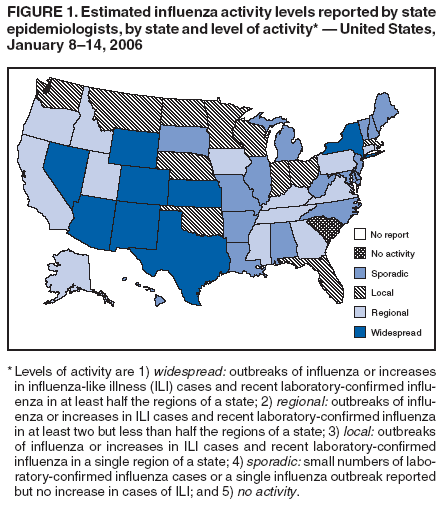
Influenza Map--through Jan. 14, 2006
-
Printer Friendly|#| Trackback
| |
1
|
2 |
3 |
4 |
|
5
|
6 |
7
|
8
|
9 |
10 |
11
|
| 12 |
13 |
14 |
15 |
16 |
17 |
18
|
|
19
|
20 |
21 |
22 |
23 |
24 |
25 |
|
26
|
27 |
28 |
|
|
Jan Mar
|
